
Guide
House edge and casino odds: what every game costs you
Every casino game is priced through its house edge. How the edge is built into payouts, typical figures by game, and why staking systems cannot remove it.
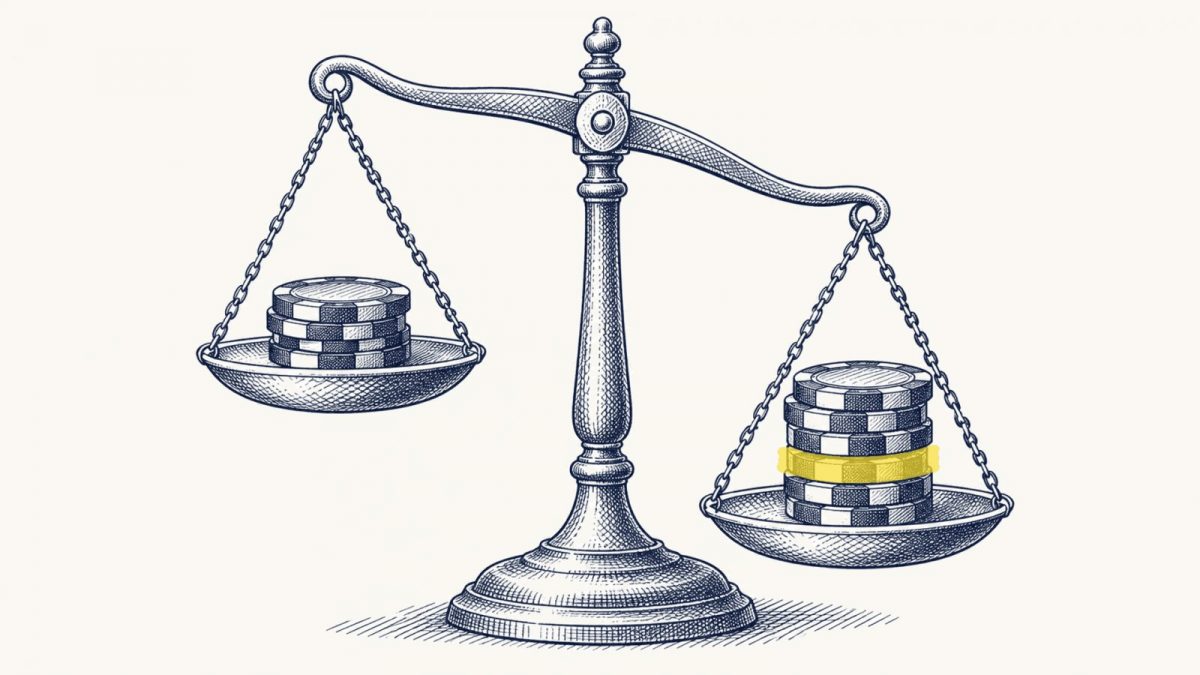
The house edge is the average share of every stake that a casino game keeps over the long run. It is built into the payouts: a bet pays slightly less than its true odds, and that small gap, repeated across thousands of rounds, is how the casino earns. A game with a 2.7% house edge keeps about £2.70 of every £100 wagered on average, and returns the other £97.30 as winnings.
On this page
Where the house edge comes from
Take a straight-up bet on a European roulette wheel. There are 37 pockets, so the true odds against your number are 36 to 1. The table pays 35 to 1. If you bet £1 on every number for 37 spins, you stake £37 and expect one win worth £36 back, including your stake. The missing £1 in 37 is the edge: 2.70%.
Every casino game works the same way, even where the mechanism is less visible. In baccarat it is the 5% commission on Banker wins; in blackjack it is the rule that the player acts first and loses on a bust even if the dealer busts too; in slots it is the gap between the return to player (RTP) and 100%. Return to player and house edge are two sides of one number, explained further in RTP explained.
House edge by game: typical figures
| Game and bet | Typical house edge | What sets it |
|---|---|---|
| Blackjack with basic strategy | Around 0.5% to 1% | Table rules: blackjack payout, number of decks, dealer on soft 17, doubling and splitting rules |
| Baccarat, Banker | About 1.06% | 5% commission on winning Banker bets |
| Baccarat, Player | About 1.24% | Drawing rules favour the Banker hand slightly |
| French roulette, even-money bets with La Partage | About 1.35% | Half the stake returned when zero lands |
| Craps, Pass Line | About 1.41% | Dice probabilities |
| European roulette | 2.70% | One zero pocket |
| Online slots | Commonly 3% to 6% | The build's RTP, chosen by the casino from the provider's versions |
| American roulette | 5.26% (7.89% on the five-number bet) | Zero and double zero |
| Baccarat, Tie at 8 to 1 | About 14.4% | Payout well below true odds |
These are typical figures under common rules. The exact number for any table or game is set by its rules and paytable, which the game's help screen shows. Blackjack's figure assumes you play every hand by basic strategy; mistakes push the edge up, sometimes several times over.
The best odds in casino roulette and other tables
If you are looking for the best odds in casino roulette, choose the wheel before the bet. On a single-zero European wheel every standard bet carries the same 2.70% edge, whether it is red or black or a single number. A French table with La Partage halves that on even-money bets. An American double-zero wheel roughly doubles it. Bet selection changes how often you win and how much, not the cost; the roulette bets guide sets out every bet with its true odds.
Across the casino floor, the lowest edges are found where the rules are simple and the payout is close to fair: blackjack played correctly, the Banker and Player bets in baccarat, and the Pass Line in craps. Side bets almost always carry far higher edges than the main game they sit beside.
Why no strategy beats the house edge
Each round of a casino game is independent: the wheel, the dice and the random number generator have no memory. Staking systems such as the Martingale (doubling after each loss), the Fibonacci or the D'Alembert only rearrange the size of your bets. They produce frequent small wins and occasional very large losses, and the long-run cost is still the house edge multiplied by everything you stake.
There are two narrow exceptions in theory, and neither helps online. Correct decisions in blackjack reduce the edge to its minimum but do not remove it; card counting, which can tilt live blackjack in a land-based setting, does not work against software that reshuffles every hand, as the blackjack strategy guide explains. Player-versus-player poker is different again: the casino takes a fee from the pot or a tournament entry rather than holding an edge.
House edge, time and the real cost of a session
The edge applies to every pound you stake, not just to the money you bring. If you start with £50 and keep re-betting your winnings, you might stake £500 in total over an evening; at a 2.7% edge, the expected cost is about £13.50, and at a 5% slot edge about £25. Fast games and long sessions multiply the turnover.
GB rules slow some of this down. Online casino games other than slots must take at least 5 seconds per game cycle, and online slots at least 2.5 seconds per spin, with autoplay banned on both. Casino sites must also show you your net position and time spent while you play. Use those figures: they are the house edge made visible.
A sensible approach is to treat the expected cost as the price of entertainment and to set a budget and a time limit before you start. Gambling is for adults aged 18 and over; the responsible gambling page covers deposit limits, time-outs and free support.
Questions readers ask
What is the house edge in simple terms?
It is the percentage of all money staked on a game that the casino expects to keep over a long run. A 2% edge means about £2 kept for every £100 wagered.
Which casino game has the best odds?
Blackjack played with basic strategy usually has the lowest edge, followed by the Banker and Player bets in baccarat and even-money bets on French roulette with La Partage.
Can a betting system remove the house edge?
No. Systems change bet sizes, not the odds of each round. The expected loss stays equal to the edge multiplied by the total amount staked.
Does the house edge mean I will lose every session?
No. Over a short session anything can happen. The edge describes the average across a very large number of rounds, which is why the casino profits over time.