
Guide
Blackjack strategy: the rules, basic strategy and why card counting fails online
How blackjack is played, how basic strategy is worked out and applied, and an honest look at card counting online and at live tables.
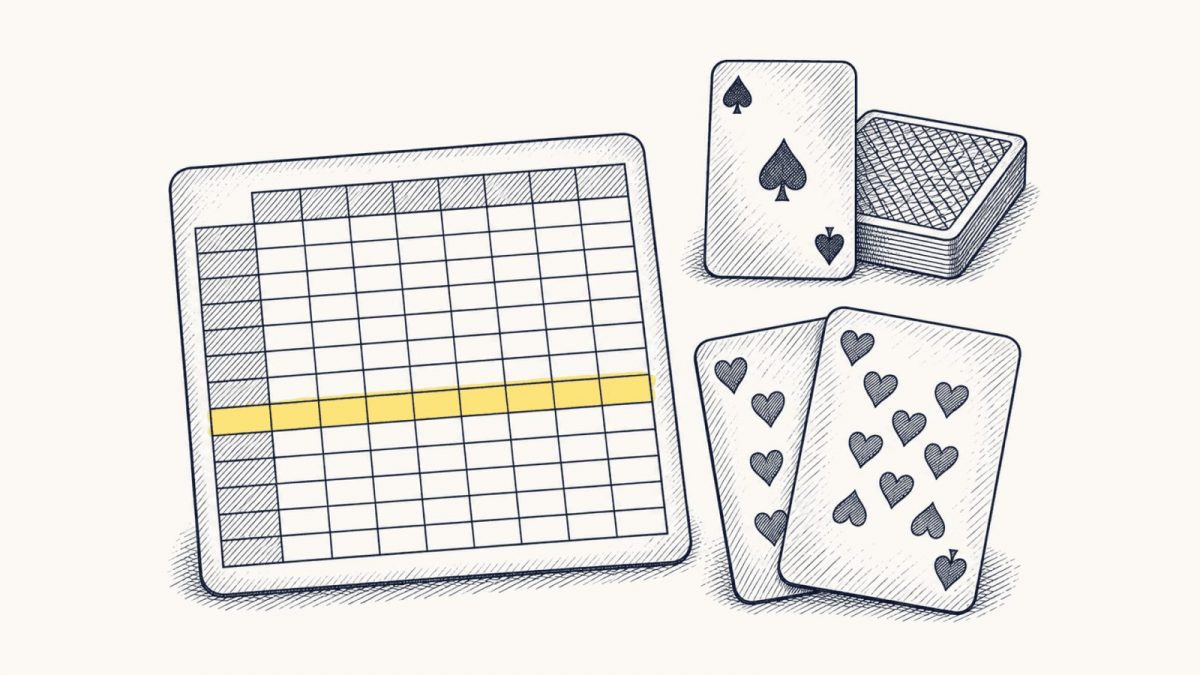
Blackjack strategy starts with basic strategy: a fixed set of decisions for every combination of your hand and the dealer's up-card, worked out by computer to give the lowest possible house edge under a table's rules. Played correctly it brings the edge down to roughly 0.5% to 1% on common rule sets, but it does not remove it. Card counting can shift the odds in a land-based game with a deep shoe; at online casinos it does not work, for reasons explained below.
On this page
How a round of blackjack works
You and the dealer each get two cards; one of the dealer's is face up. Cards 2 to 9 count at face value, tens and picture cards count 10, and an ace counts 1 or 11. The aim is to finish closer to 21 than the dealer without going over. An ace with a ten-value card as your first two cards is a blackjack, usually paid at 3 to 2.
You act first: hit (take a card), stand, double (double the stake for exactly one more card), split a pair into two hands, and on some tables surrender half the stake. The dealer then plays by fixed rules, typically drawing to 16 and standing on 17. If you bust, you lose even if the dealer later busts too, and that ordering is the source of the house edge. For the variations on payout, decks and dealer rules, see the main online blackjack guide.
What basic strategy is and how it was worked out
Basic strategy is not a hunch or a system. For each starting situation, a computer simulates the result of hitting, standing, doubling, splitting and surrendering over millions of hands and picks the option that loses least or wins most on average. The result is a chart: your hand down one side, the dealer's up-card across the top, an action in every cell. Charts differ slightly by rules, so a chart for six decks with the dealer standing on soft 17 is not identical to one for a single deck.
Key decisions from a standard basic strategy chart
For a multi-deck game where the dealer stands on soft 17, these are the decisions players most often get wrong:
| Your hand | Dealer shows | Basic strategy |
|---|---|---|
| Hard 17 or more | Any | Stand |
| Hard 13 to 16 | 2 to 6 | Stand |
| Hard 12 to 16 | 7 to ace | Hit |
| Hard 12 | 2 or 3 | Hit |
| Hard 11 | 2 to 10 | Double |
| Hard 10 | 2 to 9 | Double |
| Soft 18 (ace-7) | 9, 10 or ace | Hit |
| Pair of aces or eights | Any | Split |
| Pair of tens or fives | Any | Never split |
| Insurance | Ace | Decline |
The logic behind the pattern: when the dealer shows 2 to 6, they are more likely to bust, so you avoid risking a bust yourself; when they show 7 or higher, standing on a weak total usually loses. Insurance is a side bet that the dealer has blackjack and carries a high edge for a player who is not counting cards.
How card counting works in principle
Card counting tracks which cards have left a shoe. In the widely taught Hi-Lo method, cards 2 to 6 count +1, 7 to 9 count 0, and tens and aces count -1. A high running count, divided by the decks remaining to give the "true count", means the remaining cards are rich in tens and aces, which favours the player slightly: blackjacks become more likely and the dealer busts more often. A counter raises stakes when the count is high and bets the minimum otherwise.
The advantage is small, needs many hours, and depends on cards being dealt deep into a shoe before it is reshuffled. Card counting is not illegal: it is simply keeping track in your head. Casinos are, however, entitled to refuse play or restrict stakes for players they believe are counting.
Why card counting does not work at online casinos
- RNG blackjack deals from a freshly shuffled virtual deck every hand. Nothing carries over, so there is nothing to count.
- Live dealer tables use real shoes, but they are typically cut early and reshuffled long before the count can build a meaningful edge, and some tables use continuous shuffling, which returns used cards straight away.
- Bet spread - counting only pays when you raise your stake sharply in good counts. Many live games are shared tables with set stake ranges, which limits that spread.
A blackjack card counting app can be a reasonable way to practise mental arithmetic or learn basic strategy decisions, but it cannot give you an edge against an online game. The house edge guide compares blackjack's edge with other games.
Using blackjack strategy at online tables
Choose tables that pay 3 to 2 on blackjack rather than 6 to 5, and read the rules panel for decks and dealer behaviour before you sit down; live blackjack tables show these in their info screen. Avoid side bets if your aim is the lowest edge. Blackjack is not covered by the £5 slot stake limit, but online table games in Great Britain must take at least 5 seconds per round and cannot be autoplayed. Even with perfect play, the casino keeps its share over time; set a budget first. Gambling is for adults aged 18 and over, and the responsible gambling page lists free support.
Questions readers ask
Is card counting illegal in the UK?
No. Keeping track of cards in your head is not a crime, but casinos may refuse play or limit stakes for anyone they suspect of counting.
Can you count cards in online blackjack?
Not usefully. RNG games reshuffle every hand, and live tables reshuffle early or continuously, so the count never builds a reliable advantage.
How much does basic strategy reduce the house edge?
On common multi-deck rules it brings the edge to roughly 0.5% to 1%. Playing by instinct typically costs several times more.
Should I take insurance in blackjack?
Basic strategy says no. Insurance is a separate bet on the dealer having blackjack and carries a high house edge.